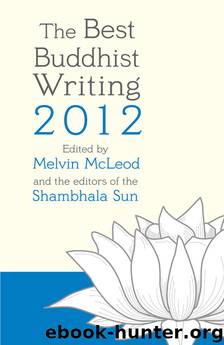
The Best Buddhist Writing 2012 by Melvin McLeod
Author:Melvin McLeod
Language: eng
Format: epub, mobi, azw3
Publisher: Shambhala Publications
Across Many Mountains
Yangzom Brauen
It doesn’t happen often, but there are times in history when a whole people acts so bravely and morally in the face of injustice that we must think of them as heroes. In today’s world, the Tibetan people are such heroes—for their resistance at home, resiliency in exile, and above all for never wavering from their Buddhist ideals of compassion and nonviolence in the face of terrible repression and cruelty. We learn much of the Tibetan spirit from Across Many Mountains, the inspiring story of three generations of Tibetan women. Here Yangzom Brauen describes her grandmother and mother’s escape from Tibet following the Chinese invasion.
For fear of Chinese soldiers, they dared walk only through the freezing nights, with no light to guide them but the stars. The mountains were black towers before the dark sky. The group, numbering a dozen or so, had set out shortly before the Tibetan New Year festival, which, like the beginning of the Chinese calendar, usually falls on the second new moon after the winter solstice. New Year was deemed the best time to escape. The high passes were covered in snow, and icy winds whistled across them, but the snow was frozen hard at night and was sometimes even stable by day, in contrast to the warm season, when trekkers sank knee- or navel-deep into a mixture of snow, ice, water, mud, and scree. It was common knowledge that the Chinese border guards preferred to keep warm in their barracks during the winter rather than go on patrol in the biting cold. Everybody agreed that the soldiers would sooner spend the New Year festival, the most important Chinese holiday, celebrating, drinking, and playing cards than doing their actual duties.
My mother’s heart beat wildly as she struggled to keep up with the adults. She was only six years old.
Soon they caught sight of danger looming in the distance. In the valley far below their path, they saw large, brightly lit buildings. They could only be housing Chinese soldiers; Tibetans had no such huge and uniformly built houses as these, with such bright lights. Shouting voices, crashes of music, laughter, and sometimes terrifying screams emanated from the buildings, echoing off the mountain. The Chinese soldiers loved chang, Tibetan barley beer, and barley liquor, and they presumably had plentiful supplies. The sounds were bloodcurdling, like a herd of wild beasts gathering in the distance. But her mother whispered to soothe her. “It’s good that they’re celebrating,” she said. “They won’t come up here if they’re cozy and warm and drunk.”
The refugees’ path was narrow and stony and barely visible in the darkness. Often the group had to pick its way through thorny scrub and fields of scree, and then carry on between low trees. The roots of the trees protruded from the ground, tripping them, and the dry branches scraped their hands and faces. All of them were covered in scratches, their feet bleeding and their clothes torn. The higher they climbed, the more often they had to cross snowfields.
Download
The Best Buddhist Writing 2012 by Melvin McLeod.mobi
The Best Buddhist Writing 2012 by Melvin McLeod.azw3
This site does not store any files on its server. We only index and link to content provided by other sites. Please contact the content providers to delete copyright contents if any and email us, we'll remove relevant links or contents immediately.
The Way of Zen by Alan W. Watts(6623)
Ego Is the Enemy by Ryan Holiday(5460)
The Art of Happiness by The Dalai Lama(4135)
The Book of Joy by Dalai Lama(3998)
Why Buddhism is True by Robert Wright(3460)
Spark Joy by Marie Kondo(3311)
Shift into Freedom by Loch Kelly(3205)
Happiness by Matthieu Ricard(3055)
A Monk's Guide to a Clean House and Mind by Shoukei Matsumoto(2924)
The Lost Art of Good Conversation by Sakyong Mipham(2664)
The Meaning of the Library by unknow(2582)
The Unfettered Mind: Writings from a Zen Master to a Master Swordsman by Takuan Soho(2320)
The Third Eye by T. Lobsang Rampa(2277)
Anthology by T J(2221)
Red Shambhala by Andrei Znamenski(2208)
The Diamond Cutter by Geshe Michael Roach(2070)
Thoughts Without A Thinker: Psychotherapy from a Buddhist Perspective by Epstein Mark(2031)
Twilight of Idols and Anti-Christ by Friedrich Nietzsche(1900)
Advice Not Given by Mark Epstein(1886)
